
I. Overview
With the deterioration of the environment and scarcity of resources, energy conservation and emission reduction have become one of the key priorities in the work of governments across China and the world. To this end, governments of all countries have increased investment in the research and development of relevant technologies and the promotion of products for energy conservation and emission reduction. In light of China's economic structure and the layout of high-energy-consumption industries, energy conservation and emission reduction in the industrial sector will be the top priority. Therefore, the energy-saving renovation of motor systems stands as the primary task, and there are mainly two development directions for such renovation:
Realization of Energy Saving and High Efficiency of Motor Body
Realization of Energy Saving and High Efficiency of Transmission System
The direct-drive three-phase permanent magnet synchronous motor embodies both aforementioned development directions of energy-saving renovation simultaneously.
Under the condition of basically the same weight, the efficiency of a three-phase permanent magnet synchronous motor is on average approximately 4%-10% higher than that of an ordinary asynchronous motor, varying with the load rate.
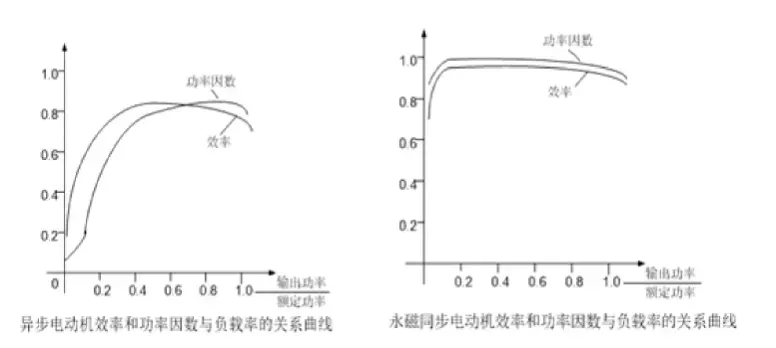
It can be seen from the above figure: As long as you keep using permanent magnet motors, you will keep making money (saving electricity bills).
When the efficiency of a drive motor is raised to a relative limit, it becomes extremely difficult and costly to further improve motor efficiency. Therefore, it is necessary to carry out energy-saving renovation on the mechanical transmission system on this basis, simplify the transmission links of the power system, shorten the transmission chain, and thereby improve the operating efficiency of the motor system. This calls for a drive motor with low speed and high torque. Limited by its inherent characteristics, an asynchronous induction motor cannot achieve low speed and high torque. In contrast, a permanent magnet motor relies on rare-earth permanent magnet materials to provide the excitation magnetic field. Its stator winding can adopt the fractional-slot concentrated winding technology to solve the problem of excessive stator slots in motors with a large number of poles, enabling it to directly meet the speed and torque requirements of the load.
Permanent magnet motor direct drive technology refers to adopting low-speed and high-torque three-phase permanent magnet motorized pulleys to replace the traditional drive system consisting of asynchronous motors and gear reducer boxes.
Traditional large mechanical equipment mainly involves low speed and high torque operation, which is realized by asynchronous motors combined with gear reducer boxes. It features numerous transmission links, a long transmission chain, and low transmission efficiency.
Belt conveyors are typical representatives of such mechanical equipment. As shown in the figure below:
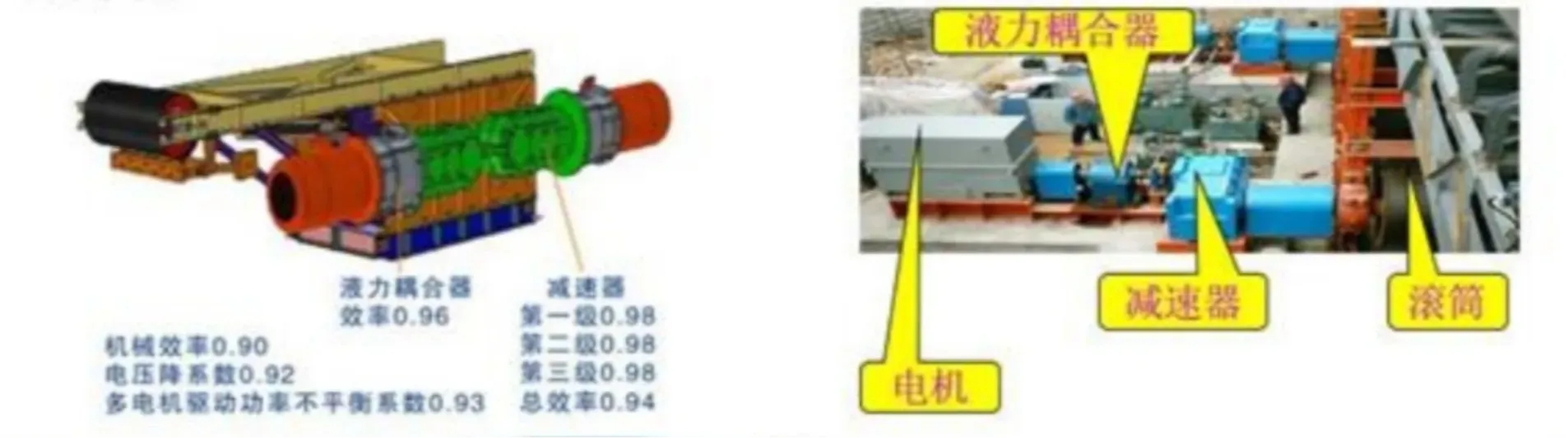
The roller is directly driven by a direct-drive three-phase permanent magnet synchronous motor, eliminating the need for a reducer, hydraulic coupling and a set of couplings. It features high efficiency and energy saving, low noise, compact structure, reliable operation, reduced maintenance and stable running.
Most conventional belt conveyors are equipped with asynchronous motors, which generally operate at a relatively low load rate. As can be seen from the above efficiency-load rate curve, asynchronous motors working under such operating conditions have low efficiency and power factor. Meanwhile, the reduction ratio of the matched reducer is approximately 20 to 40, and gearboxes with a large reduction ratio also have relatively low efficiency.
Permanent magnet direct drive technology is a groundbreaking new technology developed in recent years. Low-speed permanent magnet motors feature high reliability, low speed and high torque, adaptability to harsh environments, improved transmission system efficiency, greatly reduced overall system vibration, lower system maintenance requirements, and extended service life of the system. These excellent characteristics make it the preferred choice for energy-saving technological transformation of heavy-duty equipment such as belt conveyors.
II. Technical Characteristics of Permanent Magnet Drum Motor Direct Drive Technology
① It features a simple structure and eliminates components such as reducers, hydraulic couplings and shaft couplings. It greatly saves space, occupying only 20% of the original space, and reduces infrastructure costs.。
It has a simple external structure, with the permanent magnet synchronous motor integrated directly into the roller. For the STYB series industrial intelligent roller, the shaft remains stationary and serves as the stator of the motor; the roller surface acts as the motor rotor. Traditional electric excitation is eliminated. When symmetrical three-phase alternating current is supplied, the motor operates, which in turn drives the roller to work.
② Compared with the original system, the maintenance workload and investment in maintenance materials are reduced by 75%.
The drive unit features a simple structure consisting only of a driver and a roller. It abandons the traditional three-in-one layout of electric motor, coupler plus reducer, and drive roller, cutting 75% of the original system's maintenance workload, maintenance material investment, and potential safety hazards during inspection and maintenance.
③ Mitigate the problem of equipment shaft center misalignment caused by terrain changes during operation in the existing structure
The integrated design of the industrial intelligent roller solves the problem of shaft coupling misalignment in the original system caused by pressure changes on the roadway floor during system transmission, greatly improving the reliability of system installation and reducing the failure rate.
④ Greatly reduce energy consumption and save electricity costs, with the average energy consumption decreased by about 40%
The industrial intelligent drum itself is a permanent magnet synchronous motor, which has the following main energy-saving characteristics:
A.Adopting an integrated structure (integrating the motor directly into the drum), it delivers high direct transmission efficiency with a mechanical transmission efficiency close to 100%. Its energy efficiency level meets the national Class 1 energy efficiency certification standards.
B.High inherent efficiency. Adopted optimized magnetic circuit design, replaced electric excitation with NdFeB permanent magnets, and applied high-permeability silicon steel sheets.
C.High operating efficiency. At the rated speed of 25%-100%, the efficiency reaches 93%-97%. Under a load of 10%-100%, the efficiency of the STYB series industrial intelligent drum remains basically unchanged.
D.High power factor. The power factor of the STYB series industrial intelligent drum remains basically unchanged as the load varies.
Comparison of advantages and disadvantages between permanent magnet motor direct drive system and several existing common transmission modes:
| Drive Mode | Reliability | Power Balance | Start and Stop | Transmission Efficiency | Operating cost | Speed regulation performance | Spare Parts Conditions |
|---|---|---|---|---|---|---|---|
| Asynchronous Motor + CST | Poor stability, complex system, high failure rate, heavy maintenance workload and high maintenance cost. | It can be implemented with average performance. | It can achieve soft start and soft stop, but has poor low-speed performance. | Average. | Average performance, requires regular oil changes. | Poor speed regulation performance with slip power loss existing. | The cost of spare parts is relatively high, especially with frequent fluctuations in oil prices. |
| Asynchronous Motor + Hydraulic Coupling + Reducer | The failure rate of the hydraulic coupling is high; the motor bearing is at risk of poor lubrication and must be replaced during major overhaul. | Poor performance with high mechanical loss. | Poor soft start and soft stop performance, as well as inferior low-speed performance. | Low. | High oil consumption, requiring regular oil changes. | Limited torque fluid couplings have no speed regulation capability, and variable speed fluid couplings feature poor speed regulation performance with slip power loss existing. | Spare parts for speed reducers, fluid couplings and gear reducers require a large amount of maintenance equipment and working hours during maintenance. |
| Asynchronous Motor + Frequency Converter + Reducer | There is a risk of poor lubrication for motor bearings, which must be replaced during major overhaul; the reducer requires heavy maintenance and incurs high maintenance costs. | It can realize double closed-loop control with high control precision. | Soft start and soft stop can be realized. | Relatively high. | Average performance, requires regular oil changes. | Excellent speed regulation performance. | Inverter spare parts, reducer spare parts. A large amount of maintenance equipment and working hours are required for maintenance. |
| Direct-drive Permanent Magnet Motor + Inverter | No reducer design, low-speed motor bearings feature long service life, high reliability and virtually maintenance-free operation. | It can realize double closed-loop control and achieve higher control precision of synchronous motors. | By adjusting the frequency, soft start/stop is achieved with a wide adjustable time range. | Maintain high efficiency over a wide load range. | Basically maintenance-free, oil-free and pollution-free with excellent energy-saving effect. | It features excellent speed regulation performance, high precision and fast response. | Only frequency converter spare parts are required |