
Power consumption constitutes the largest portion of the operating costs for desulfurization systems in coal-fired power plants, accounting for over 80% of total desulfurization expenses. The power used by desulfurization systems exceeds 1% of a plant’s total power generation, translating to a standard coal consumption of 3 to 6 g/kW·h. Therefore, research on operational optimization for desulfurization systems in coal-fired power plants holds great potential and practical significance for improving the economic performance and cutting operating costs of thermal power plants.
As one of the key pieces of equipment in limestone-gypsum wet flue gas desulfurization systems, slurry circulating pumps consume approximately 65% to 76% of the total power of the entire desulfurization system. Given its dominant power consumption share, energy conservation and consumption reduction for slurry circulating pumps are of vital importance.
Due to the critical role of slurry circulating pumps, a number of new retrofitting technologies have emerged in recent years, each with distinct advantages and disadvantages. This paper compares and analyzes several mainstream configuration schemes for slurry circulating pumps as follows.
Scheme 1: Conventional Asynchronous Motor + Reducer + Slurry Pump
This is the most prevalent and widely applied configuration currently. It adopts a standard high-voltage 4-pole asynchronous motor. The motor drives the slurry pump via a reducer to lower the speed to 400 rpm ~ 600 rpm. The pump is a large-flow, low-head type with excellent wear and corrosion resistance.
Advantages
The system features a simple and reliable structure with high transmission efficiency. All components are proven mature products, delivering easy operation and maintenance.
Disadvantages
The motor adopts direct-on-line starting, which causes severe impact on the whole system. It may easily lead to broken gear teeth, severe bearing wear and coupling damage in the reducer, resulting in heavy maintenance workload.
The system runs at a constant speed. When operating conditions change, the flow can only be adjusted by starting or stopping additional pumps. Lacking flexible regulation methods, it fails to achieve real-time and precise adjustment according to actual demands, leading to substantial energy waste and unstable slurry conditions inside the absorption tower.
Scheme 2: Low-speed Motor + Slurry Pump
This configuration is relatively uncommon. Some facilities have upgraded from Scheme 1 to this solution to reduce heavy maintenance work. It uses a low-speed permanent magnet synchronous motor to drive the slurry pump directly with the reducer removed. The original large-flow, low-head wear-resistant and corrosion-resistant pump is retained.
Advantages
The system structure is further optimized. The removal of intermediate components such as the reducer simplifies the transmission chain, cuts down power loss during power transmission and improves overall system efficiency.
The motor features high starting torque and strong load-carrying capacity. There is no need for gear oil replacement or gearbox maintenance, which reduces the number of components requiring upkeep.
Disadvantages
Compared with conventional asynchronous motors, this motor is larger and heavier, requiring more installation space. Corresponding supporting facilities and auxiliary components also need to be upgraded to larger specifications.
Although direct-on-line starting is available for permanent magnet motors, it brings strong system impact and accelerated equipment wear, increasing maintenance frequency. To mitigate such impact, an additional frequency converter is generally required, which raises upfront investment. High-voltage frequency converters consist of electronic components that generate harmonic interference during operation. With numerous electronic parts prone to aging, the equipment has strict environmental requirements, rising failure rates over service life, poor long-term reliability and high later-stage maintenance costs. In addition, a dedicated power distribution room equipped with air conditioning is required to house the converters.
Currently, low-speed low-power permanent magnet synchronous motors have well-developed technology. However, for low-speed high-power models, it is difficult for the bearings to form a stable lubricating oil film for long-term operation at low speeds, and bearing service life has become a major constraint on their application. Meanwhile, its overall reliability still needs further verification due to limitations in material selection and heat dissipation performance.
Similar to Scheme 1, the system operates at a fixed speed. Operation adjustments can only be realized by switching pumps on or off when working conditions fluctuate. The absence of flexible regulation results in excessive energy consumption and unstable slurry in the absorption tower.
Scheme 3: Conventional Asynchronous Motor + Permanent Magnet Governor + Reducer + Slurry Pump
Based on Scheme 1, an oil-cooled permanent magnet governor is installed between the motor and the reducer. The motor, reducer and slurry pump remain the original equipment used in Scheme 1.
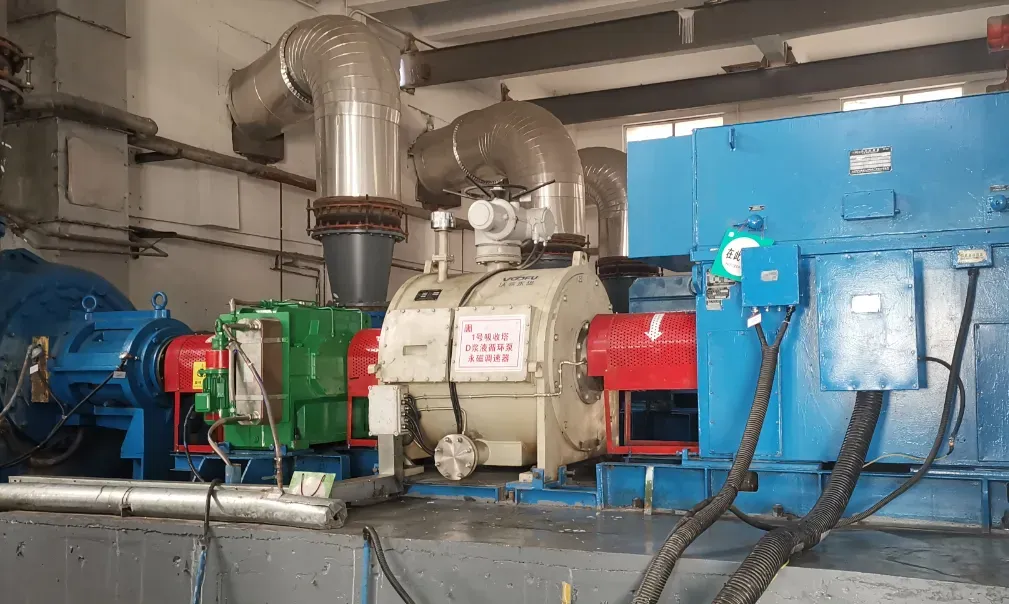
Retrofit Case of Voofu High-Power Oil-Cooled Permanent Magnet Governor for 1400kW 1480rpm TW850 Slurry Circulating Pump at Datang Xinyang Power Plant
Advantages
(1) The high-power oil-cooled permanent magnet governor is a groundbreaking new technology developed in recent years. It transmits torque via non-contact magnetic force, featuring advanced technology and high reliability, with abundant proven cases for reference.
(2) It enables real-time and precise speed regulation of the load. While meeting process requirements, it reduces operating speed to achieve remarkable energy savings. Proven by numerous projects, its energy-saving rate ranges from 25% to 40%. For an 800 kW motor, the annual power saving can exceed 1.2 million kWh.
(3) The original rigid connection between equipment is replaced with non-contact flexible connection. This solves shaft alignment issues and reduces equipment vibration. Its soft start function mitigates mechanical impact, improves the reliability of motors and loads, and cuts maintenance workload.
(4) As a purely mechanical speed regulation device, the permanent magnet drive boasts high reliability. It delivers superior performance in harsh environments such as humid and dusty conditions. The overall service life can exceed 25 years, and no routine maintenance is required during operation.
(5) The permanent magnet governor consumes no extra power and generates no high-order harmonics. It will not cause motor overheating even under low-speed operation.
Disadvantages
The added permanent magnet governor occupies extra space, extending the overall shaft length by approximately 1.3 meters. For retrofitting projects, the motor needs to be moved backward, which requires sufficient installation space. This issue does not exist for new-built projects.
A comparison of the three configuration schemes shows that although Scheme 3 incorporates an additional permanent magnet drive component and seems more complex, the permanent magnet governor is a fully mature product with maintenance-free operation. It reduces vibration and mechanical impact, and delivers substantial economic benefits through variable-speed operation and energy saving realized by real-time precise regulation.
Currently, there are multiple technical solutions for permanent magnet governors. Based on years of field application data, the disc-type symmetric oil-cooled permanent magnet governor stands out in two core indicators: support for high-power loads and operational stability. It has the most extensive application records, supports a maximum power of 5000 kW, and features the best operational stability. In terms of safety and reliability, it is the preferred choice for energy-saving retrofits of slurry circulating pumps in coal-fired power plants.