
Recently, there have been frequent policies in the field of energy conservation and emission reduction. At the National Conference on Ecological and Environmental Protection, General Secretary Xi Jinping required: to comprehensively promote green development, focus on adjusting the economic structure and energy structure, advance the comprehensive conservation and recycling of resources, and realize the circular linkage of production and living systems.
Statistics show that China's energy utilization efficiency is only 33%, about 10 percentage points lower than that of developed countries. Among them, the energy consumption per unit of major products in eight industries, including electric power, steel, non-ferrous metals, petrochemicals, building materials, chemicals, light industry and textiles, is on average 40% higher than the international advanced level; the comprehensive energy consumption per unit product of steel, cement and paperboard is 21%, 45% and 12% higher than the international advanced level respectively.
A permanent magnet speed governor is a purely mechanical device that operates on **Lenz's Law**. It uses **rare-earth permanent magnets** and alloy conductors to enable non-contact power transmission. By adjusting the air gap between the permanent magnet disk and the conductor disk, it freely varies the motor's output power. This achieves speed regulation and energy savings for load equipment. Representing a revolutionary new transmission method, the device requires **no electricity** for operation.
Permanent magnet transmission energy-saving technology has an average energy-saving efficiency of over 15% and can play an important role in motor energy-saving transformation and consumption reduction for industrial enterprises. However, there are multiple technical implementation routes for permanent magnet speed governors. Based on years of market application results, in terms of two key performance indicators—support for high-power loads and operational stability—the disc-type, symmetric-structure, oil-cooled permanent magnet speed governor represents the technical faction with the most practical applications, the maximum supported power (up to 5,000 kW), and the best operational stability currently available.
The oil-cooled permanent magnet governor consists of an outer sleeve, a permanent magnet device main body, an electric actuator and other components. The permanent magnet device main body is composed of a high-precision permanent magnet rotor assembly (containing high-strength permanent magnets) connected to the load shaft, and a composite conductor rotor connected to the motor shaft. There is no physical (mechanical) connection between the outer rotor and the inner rotor. The entire permanent magnet device main body is installed in a sealed outer sleeve. During operation, oil is supplied from a thin oil station and sprayed onto the permanent magnet device main body to achieve cooling and lubrication.
The main body of the oil-cooled permanent magnet equipment and the cooling thin oil station are two separate units. The pipelines connecting the oil station and the permanent magnet main body are numerous and complex. During installation, in addition to the space for the permanent magnet main body, a relatively large area must also be reserved for the cooling thin oil station. This results in low product integration and space utilization, which not only occupies more installation space but also increases the overall time and difficulty of installation and modification.
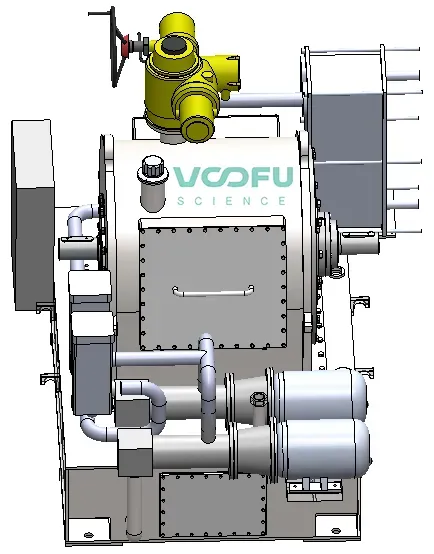
To address the above issues, the R&D team from Voofu Permanent Magnet has designed an integrated oil-cooled permanent magnet governor, which is an integrated oil-cooled permanent magnet governor that combines the permanent magnet and the thin oil station into one unit. The integrated oil-cooled permanent magnet governor integrates the permanent magnet main body and the cooling thin oil station into a single device, optimizing the oil circuits, pipelines, and equipment cooling, thus forming an integrated oil-cooled permanent magnet governor with a compact structure and a high degree of integration.
Recently, policies in the field of energy conservation and emission reduction have been frequently introduced. At the National Ecological and Environmental Protection Conference, General Secretary Xi Jinping required: to comprehensively promote green development, focus on adjusting the economic structure and energy structure, advance the comprehensive conservation and recycling of resources, and realize the circular linkage of production and living systems. Statistics show that China's energy utilization efficiency is only 33%, about 10 percentage points lower than that of developed countries. Among them, the unit energy consumption of major products in eight industries, including electric power, steel, non-ferrous metals, petrochemicals, building materials, chemical industry, light industry and textile, is 40% higher on average than the international advanced level; the comprehensive energy consumption per unit product of steel, cement and paperboard is 21%, 45% and 12% higher respectively than the international advanced level. A permanent magnet speed regulator, which utilizes Lenz's law, adopts rare earth permanent magnets and alloy conductors, and adopts a non-contact transmission method by adjusting the air gap between the permanent magnet disk and the conductor disk, so as to achieve free change of motor output power and realize speed regulation and energy saving of load equipment. It is a revolutionary new transmission method, and the equipment is completely non-electric and purely mechanical.
Oil-cooled permanent magnet governors have been promoted and applied in industries such as electric power and petrochemicals. The emergence of integrated oil-cooled permanent magnet governors has facilitated their comprehensive popularization and application across various industries. For society as a whole, the energy-saving potential of improving the operational efficiency of fan and water pump systems can reach 30~50 billion kW•h per year, equivalent to the annual power generation output of 6~10 large-scale thermal power plants with an installed capacity of 1000 MW class. This aligns with the requirements for comprehensive resource conservation, responds to the national call for energy conservation and emission reduction, and is of great practical and practical significance for establishing a sustainable ecological environment and realizing a harmonious society.