
I. Comparative Analysis of Cylindrical and Disc Type Structures
1. Overview
Although both disc-type and cylindrical permanent magnet products belong to permanent magnet speed regulation products, they are completely different in terms of application history, structure, safety, heat dissipation principle and heat dissipation effect. This paper conducts a comprehensive comparative analysis of permanent magnet speed regulators with cylindrical and disc-type structures.
2. Differences in application time and patents
Disc-type permanent magnet structure is the most widely used and earliest adopted structural form of permanent magnet coupling products at present. From invention to application, disc-type permanent magnet structures have been applied in various practical scenarios across multiple industries, and their operational safety, reliability as well as heat dissipation performance have been widely recognized by users.
The cylindrical structure permanent magnet is an alternative design developed to avoid the patents of the disc-type structure. It has a short cycle from theoretical demonstration to product production, and its operational safety and reliability have not been fully verified by sufficient time and practical application.
3. Performance Comparison
3.1 Structural Comparison
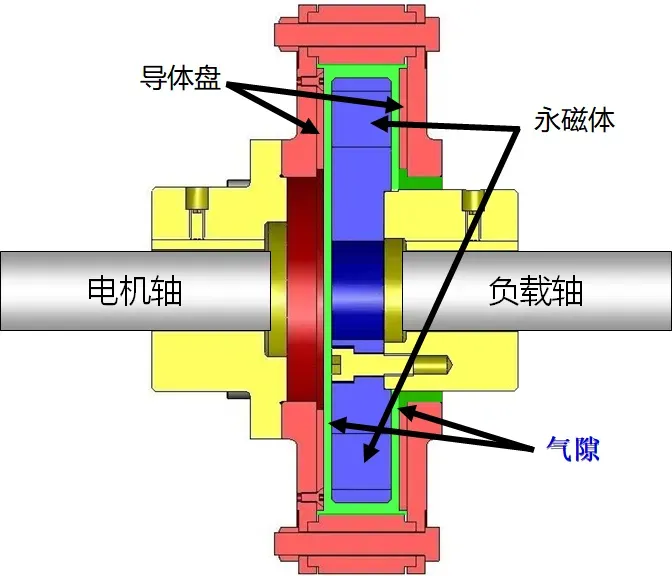
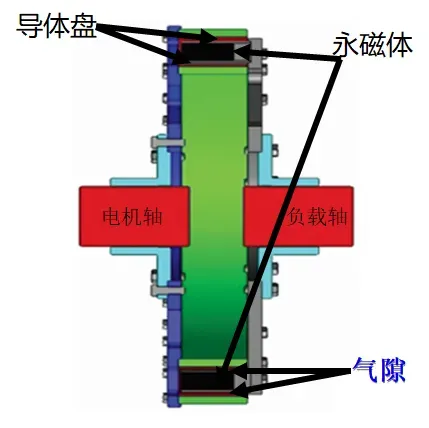
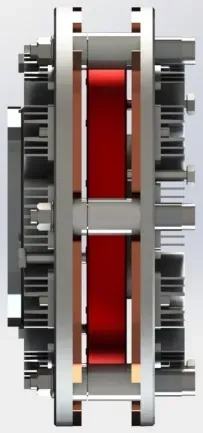
The force of the disc-type structure is axial, and it features an axially symmetrical structure that exerts no external force on connected equipment. In contrast, the force of the cylinder-type structure is radial. Due to the different diameters of the inner and outer cylinders, the structure is radially asymmetrical, resulting in radial force during operation which causes cylinder deformation. High-speed operation poses potential safety hazards.
3.2 Safety
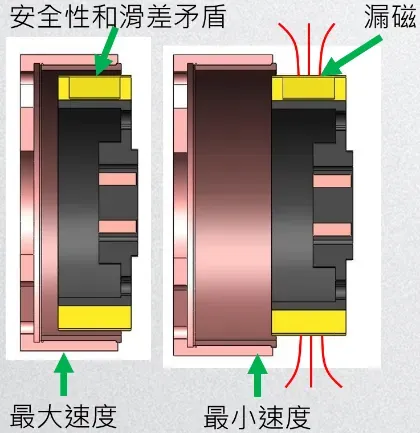
The cylindrical structure suffers magnetic leakage during adjustment, while the disc structure is permanently enclosed within a 30mm steel plate with no magnetic leakage, as shown in the figure below.
3.3、Different heat dissipation effects
There is a huge difference in heat dissipation between the disc type and the drum type, refer to the figure below.
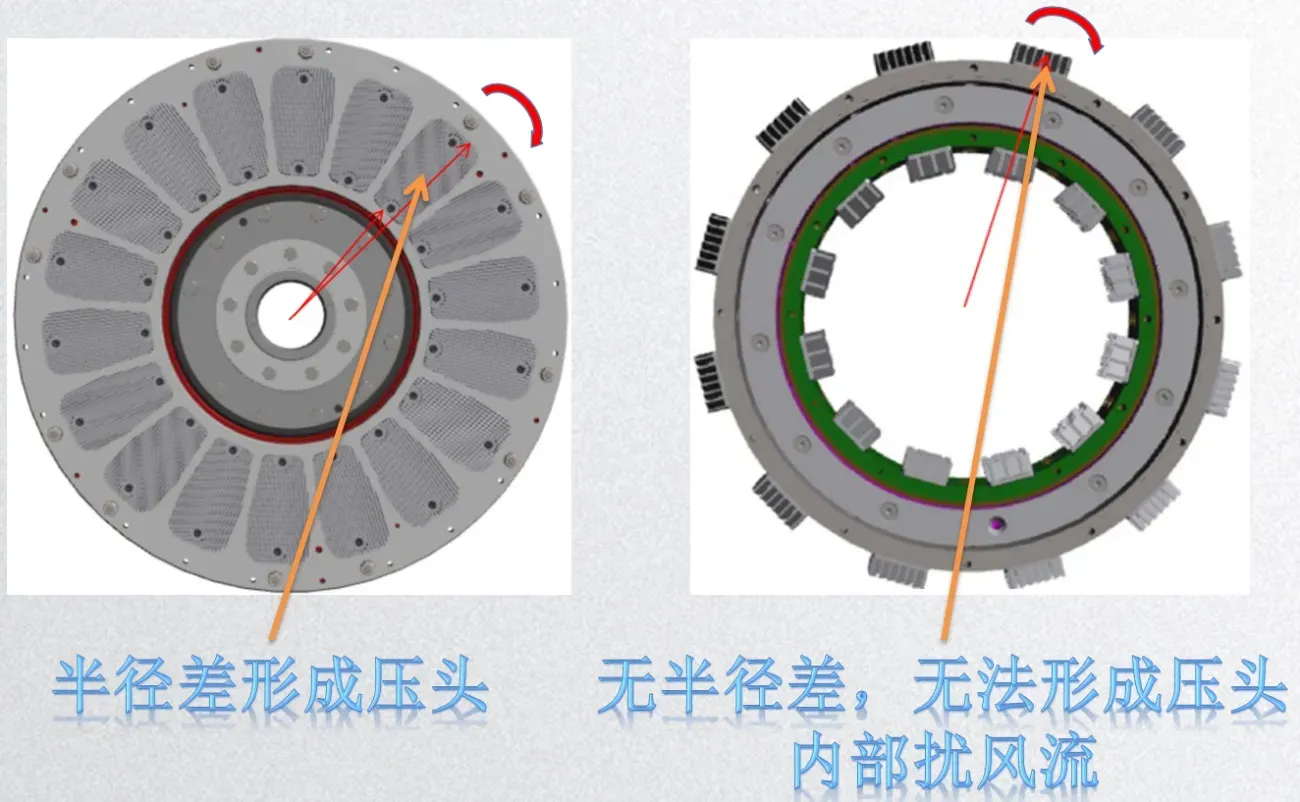
The disc structure is similar to a centrifugal fan. As the conductive steel disc rotates, a pressure difference is formed between the inner and outer sides of the cooling fins, which naturally generates pressure head and effectively dissipates heat from the steel disc. For the cylindrical structure, there is no radius difference between the rotation centers of the cooling fins and the cylinder body, resulting in ineffective heat dissipation and internal swirling airflow.
Upon further observation of the on-site application photos, it can be seen as shown in the figure below
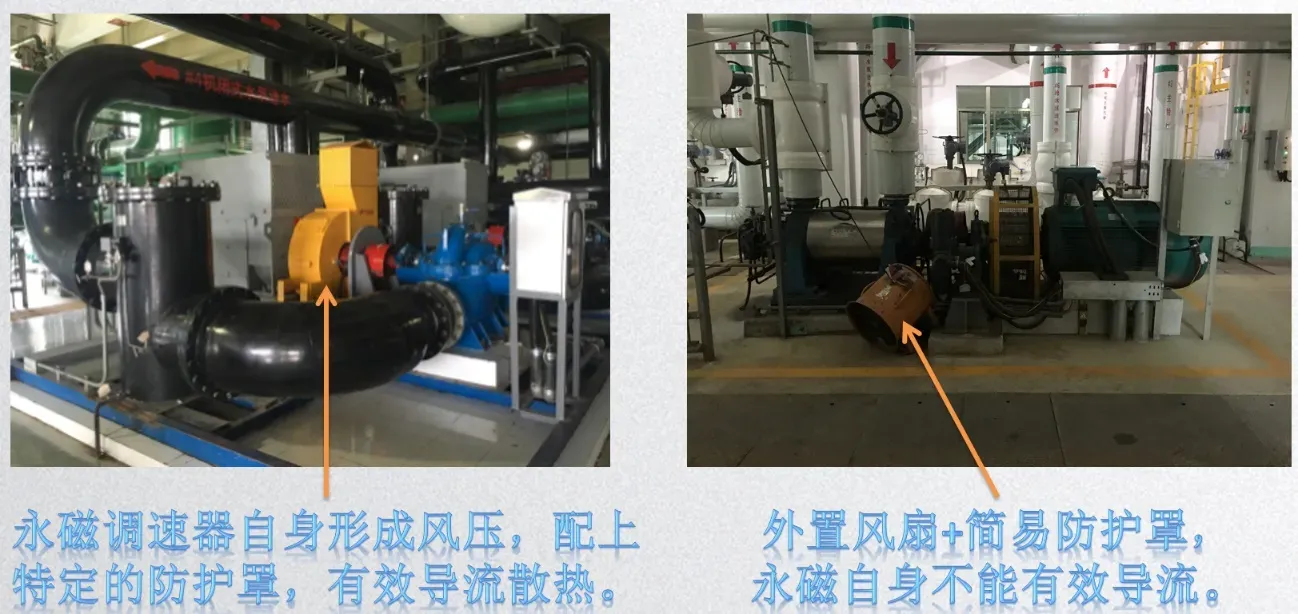
The disc type can be equipped with a centrifugal wind hood for natural heat dissipation, while the cylinder type can only adopt an open protective cover and relies on the surrounding flowing air for passive heat dissipation. If there is no wind in the environment, a forced cooling fan has to be installed, which is an inherent defect of the cylinder type.
The principle is the same as that of large-scale forced cooling, except that the air medium is replaced with water or oil. The disc type can still easily dissipate heat by using centrifugal force (with a hollow interior for full contact), while the cylinder type can only adopt shower-type heat dissipation (water-spraying style), resulting in an extremely low contact efficiency with the conductor disc.
For permanent magnets with a disc structure, the conductor disc generates almost no heat when the gap between the conductor disc and the permanent magnet is at its minimum. Heat is only produced in the conductor disc when the gap between the conductor disc and the permanent magnet is widened to a certain extent, namely when slip occurs. Featuring an open structural design, the equipment is fitted with high-efficiency heat dissipation fins externally and operates at a high speed. As a result, the heat generated by the conductor disc is not easily transferred to the permanent magnet. Moreover, the widened gap between the conductor disc and the permanent magnet further facilitates heat dissipation of the equipment.
During the speed regulation process of the cylindrical permanent magnet structure, the gap between the magnetic conductive cylinder and the permanent magnet cylinder remains unchanged, and it adopts a closed structural form. Therefore, the heat generated by the magnetic conductive cylinder during operation is more easily transferred to the permanent magnet cylinder, which endangers the service life of the magnetic steel inside the permanent magnet cylinder. Consequently, magnetic speed regulators with a disc structure have better heat dissipation performance than those with a cylindrical structure, thereby improving the overall reliability and safety of the equipment.
Two 280kW closed pumps serving as mutual backups configured for one unit at Anhui Guqiao Power Plant adopt disc-type and cylindrical structures respectively. The operating temperature of the conductor in the cylindrical structure reaches 240℃, while that of the conductor in the disc-type structure is 65℃.
This is the main reason why there are no high-power performance records for cylindrical types in the current market.
3.4 Comparison of Speed Regulation Performance
Based on years of operational cases, the disc structure allows the use of conductors made from a variety of materials, resulting in a smooth speed regulation characteristic curve (T-N) and stable speed regulation performance.
Due to its poor heat dissipation performance and the structural characteristics of conductors and reel-type steel discs, the cylindrical structure can only adopt copper as the conductor material, with extremely limited material options. In particular, it cannot maintain stable operation for high-power equipment within the speed regulation range of 50% to 80%. For example, an 800kW water pump has a head of 5kg; the cylindrical structure can hardly be adjusted to 4kg, and it directly skips the range from 3.5kg to 4.5kg, making constant pressure control at 4kg unachievable.
3.5. Differences in installation requirements and service life
The disc-type permanent magnet speed regulator features a large installation tolerance, requiring only shaft alignment deviation within 3mm and an angular deviation of 3 to 5 degrees.
The cylindrical permanent magnet speed regulator has a small allowable tolerance and relatively high requirements for installation accuracy, with an axial allowable deviation of 0.5 mm and an angular deviation of 0 degree. The inner and outer sleeves must be installed in precise alignment. Once deviation occurs (whether caused by installation errors or operational wear), rotor-stator scraping will take place (similar to the friction fault between a motor's rotor and stator). This causes the permanent magnet to heat up rapidly; if the temperature exceeds the Curie temperature of the permanent magnet, magnetic steel will become demagnetized and the equipment will be scrapped. Whether cylindrical permanent magnet speed regulators can guarantee their designed long service life requires further practical verification and theoretical demonstration.
3.6 The anti-throw safety design of the magnet in the cylindrical structure is contradictory to the gap between the magnet and the conductor disc.
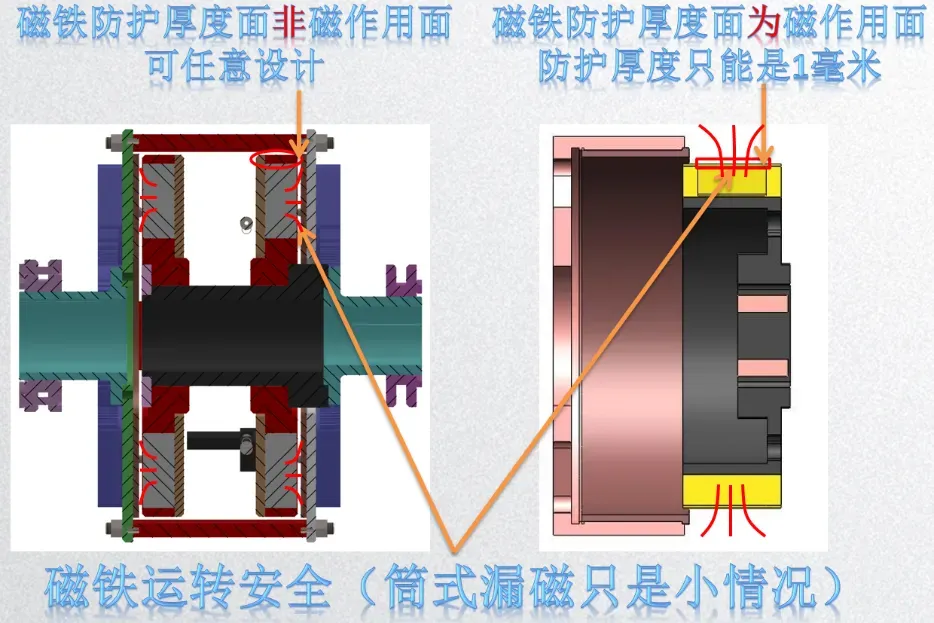
Two key considerations in the arrangement of magnets for permanent magnet speed regulators are as follows:
1. The magnets must not be thrown off, so the protective layer outside the magnets needs to be thickened (note that it must be non-magnetic isolation material, generally aluminum alloy).
2. The distance between the magnets and the conductor disc must be sufficiently close for magnetic field cutting; otherwise, the equipment performance will be compromised.
For the disc-type structure, protection is radial while the acting force is axial, with no conflict between the two. However, for the cylindrical structure, both the magnet protection and the acting force are radial, which is one of the reasons why the cylindrical structure cannot be applied to high-power equipment.
The application of disc-type permanent magnet speed regulators has accumulated extensive experience in product research and development, design and manufacturing through operation in harsh environments such as power plants, cement plants, steel mills and coal mines.
3.7 Performance Explanation
In the performance record provided by any manufacturer of cylindrical permanent magnet speed regulators on the market, there are no more than 10 project cases with a power exceeding 1000kW. This indicates that this type of structure is not yet mature and cannot be replicated in batches. In contrast, manufacturers of disc-type permanent magnet speed regulators have a large number of project cases exceeding 1000kW, which fully proves that its structure and technology are mature and reliable.
4. Summary
In summary, the structures of disc-type and cylindrical permanent magnet speed regulators are completely different, resulting in vastly different operating effects. The disc-type structure features higher safety and reliability. Constrained by its inherent structural design, the cylindrical structure has numerous inherent flaws that cannot be resolved.
The disc-type structure boasts a wealth of high-power application achievements, while the cylindrical structure has almost none.